

** Draft, Updated 7/24/21**
Introduction
Following is a story my grandmother Agnes Lilly loved to tell grandchildren.
“In 1908 I turned 19 and in May I left San Francisco for New York, then sailed to Europe with a group of girls on a sightseeing adventure arranged by Mrs. Scoville’s school and led by chaperone Miss Chisman. We toured Great Britain and Continental Europe, even sailing through Norwegian fjords. Later in the summer and upon my girlfriend’s recommendation, I decided to remain in Paris and study French language and music at a school for girls directed by American Miss Grace Lee Hess.”

To be clear, I wrote this fragment from memory. All grandchildren can. A story repeated often, one of Agnes Lilly’s most vivid memories.

But let me frame the story a different way:
In January 1908 Agnes Lilly loved her life in San Francisco. For unknown reasons, in February Father Tillmann arranged a hurried private interview between his daughter (age 18) and his widowed business partner Lewis Hanchett (age 36), at which Lew proposed marriage. Agnes Lilly considered Lew her “hero”, but before the interview Father Tillmann instructed his daughter to say “No”. Following the interview, Agnes Lilly sank into depression and began fighting with her Father, prompting family and friends to rush Agnes Lilly out of the country by June. Foreign travel helped Agnes Lilly recover. However, anxiety about returning home in September caused Agnes Lilly to make arrangements to stay in Paris.
To be clear, I wrote this from reading my grandmother’s papers.

For a grandchild like me, it was amazing to read about my grandmother’s teenage love affair and how close it came to marriage with someone other than my grandfather. For the rest of her life my grandmother (and her brother Fred) treated Lew Hanchett and his daughters Alice and Lucy as family. Love morphed into friendship. Lew remarried in 1910, and Agnes Lilly married “Bart” van Eck in 1914. And their respective spouses — like adults everywhere — acknowledged and learned to live with the special friendship between Lew and Agnes Lilly.
The story is remarkable because my grandmother’s papers hold four separate accounts of 1908 written over 65 years. Over time the general “arc” of the story remained unchanged, but underlying family drama was expunged. The four accounts include: my grandmother’s 1908 diary; eight handwritten letters from September 1908; a 1914 confessional letter to her future husband; and a 1970s pastiche of Stories for Grandchildren.

The trajectory of my grandmother’s life was altered by the events of 1908. Souvenirs brought back included the French language and an operatic voice. Agnes Lilly finally became a fluent French speaker (despite all her hard work at San Francisco’s Hamlin School for girls). And she brought back a lifetime’s love of all things French.

My grandmother also studied vocal music in Paris, and in later years when Agnes Lilly entertained family and friends with a performance of French chansons, accompanied by pianist, the audience heard a voice taught at Miss Hess’ school for girls by famed Tennessee baritone Oscar Seagle.

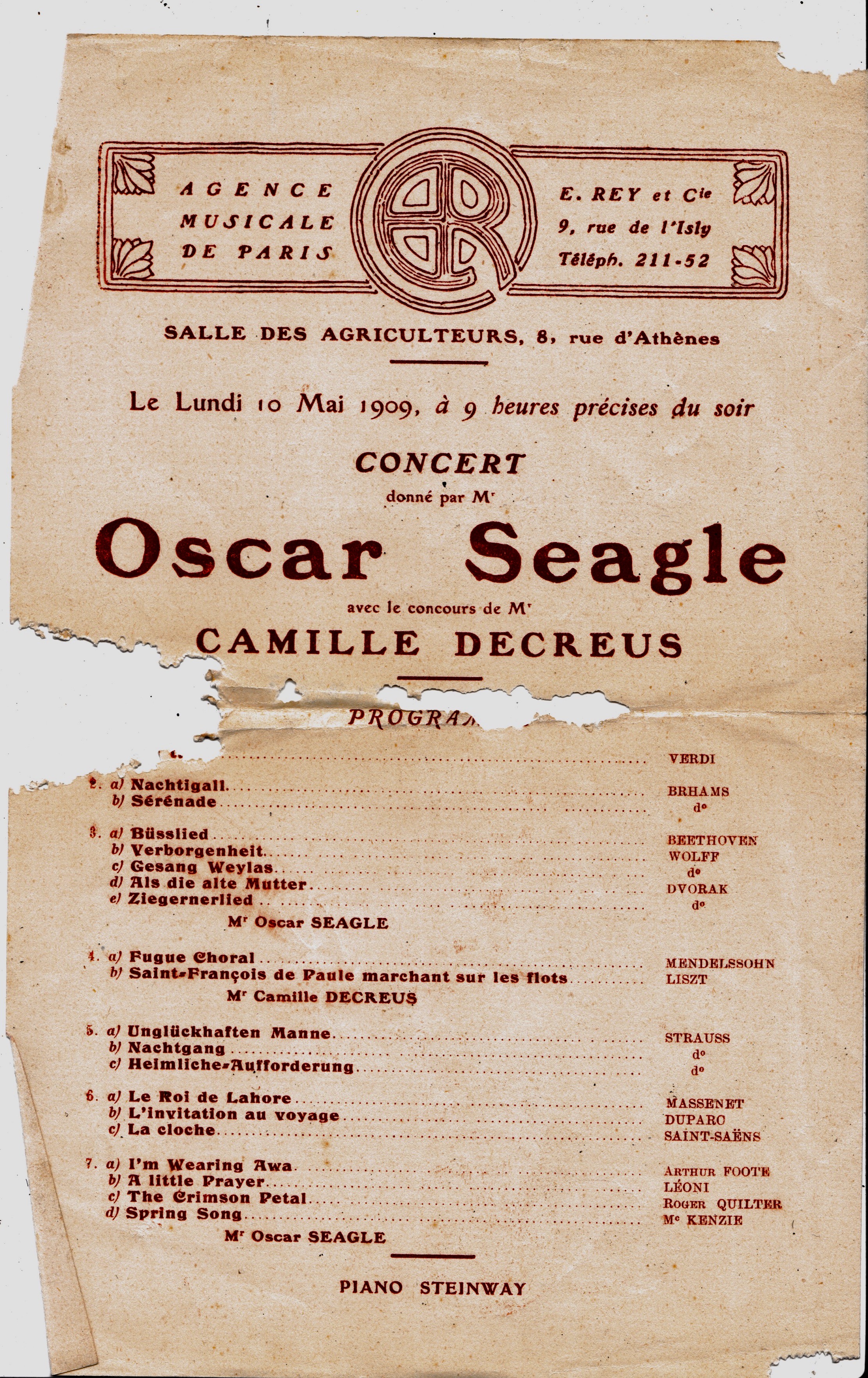
But Agnes Lilly found and brought back something even more important. She found herself. Trite, yes, but true. Agnes Lilly’s 18 months abroad taught her to be independent, to act with confidence, and to trust her judgment. Never again to be the tool of others. When she returned at the end of 1909 she brought back a new persona, having fully imbibed the “freedom of manner” of French society — mature, unflappable, assured, the center of attention, and always in charge. Yes, she returned a lady.

Despite the underlying family drama, my grandmother’s Paris letters stand on their own. A young girl’s discovery of Paris, awed by the glittering wealth of her Spreckels cousins and surrounded by musicians and artists at Miss Hess’ salon on Avenue Victor Hugo where Agnes Lilly is courted by French nobility. (Meanwhile, blocks away at rue de Fleurus gather cutting-edge writers and artists like Gertrude Stein and Pablo Picasso — alas, not our grandmother’s social circle.)

Reading the Paris letters in light of the backstory adds a dimension of first romance and family drama that is completely absent from Agnes Lilly’s “sanitized” written remembrances. This essay paints a truer picture.
Let’s start with the most recent remembrance and then work back in time.
A 1970s Remembrance of 1908
In her Stories for Grandchildren written in the 1970s, Agnes Lilly explained her decision to stay in Paris with Miss Hess as follows.
“That winter [1907/1908] I took private courses with Miss [Katherine Delmar] Burke, my faithful teacher, and she persuaded my parents in arranging for a group of twelve girls from Miss Scoville’s School in New York to go for a trip to Europe. Mother, Auntie, and [brother] Fred took me to New York by train and saw me off on the steamship to England.”

The girls were chaperoned by Miss Rose Chisman and visited European capitals, including a never-to-be-forgotten voyage to Norwegian fjords — topic for another essay.

Alas, summer is coming to a close in August and looming is Agnes Lilly’s home trip.
“Among the group of girls with whom I was travelling were three with whom I became friends. One of these was Elsie Gardner from Washington, D.C., who had been at Miss Hess’s Finishing School in Paris, 145 Avenue Victor Hugo, near the Arch de Triumph and the Bois de Boulogne. I became very much interested and wrote to ask my parents if I might consider staying over to attend the school. My father cabled that he thought it was all right for me to stay.”

“When I went on the first of September to see my group of travel friends off on the train to the steamer at Cherbourg en route to the U.S.A., it was very hard for me not to want to go with them, but my friend Elsie Gardner accompanied me to Fontainebleau where Miss Hess had a lovely little summer villa on the Loire River. I certainly enjoyed seeing the beautiful forest and flowers and visiting the Barbizon school of artists. And we called upon Rosa Bonheur, famous for her painting ‘The Horse Fair.’”

“After two weeks we returned to Paris where there were six English and four American girl students. I began to entertain the idea of school and talked it over with Miss Chisman, who took me to tea at the Pre Catelin to advise me how to approach the matter with Miss Hess, the Headmistress. Miss Hess was an American and had a salon (the idea of which began with Madame Sevigne) with entree to very interesting people — writers, artists, musicians, and well-known families — who followed the custom.“

The Stories for Grandchildren are a life history devoid of family drama. A perfect world.
Confessions in 1914
In 1914 — six years after writing the Paris letters, three months before her wedding, and 60 years before compiling her Stories for Grandchildren — Agnes Lilly bared her soul and revealed all past affairs to her prospective husband “Bart” van Eck in an eye-popping 50-page “Confessional Letter”.

With respect to the year 1908, the Stories for Grandchildren and the Confessional Letter are generally in agreement except for one MAJOR difference: Agnes Lilly’s love interest with Lewis Hanchett (“Lew”), Father Tillmann’s mid-30s business partner at the time.
Lewis Hanchett (1872-1956) was second generation California, with long roots in San Jose. Family wealth came from mining, put to use in urban railways and residential development. And Lew’s brother-in-law was George Crocker, son of Charles Crocker, one of the Big Four of the Central Pacific Railroad. Surprisingly, from 1907 on Hanchett lived right next to the Tillmanns at 2006 Washington street.

Let’s start at the beginning. Agnes Lilly (age 17) and Lew (age 34) first met in Oakland, California following the 1906 San Francisco earthquake and fire. Lew and Father Tillmann had begun collaborating on development of Hanchett Residence Park in San Jose.

The following quotation — and all quotations in this segment — come from the Agnes Lilly’s Confessional Letter to Mr. van Eck:
“That summer… brought the first man [Lew] into my life, and man a great deal older… and a friend of Father’s. I was still very bashful then and would sit evening after evening listening to the man tell of his life and experience and he began to be a kind of hero.”

“He [Lew] very seldom spoke personally to me, but on account of my great companionship with Father I was naturally drawn into the circle and Father unconsciously brought us together on every occasion, and you see his wife had died and he had two children who were very devoted to me.”

Tragically, Lew’s first wife Lucy Upson died shortly after the 1906 earthquake, leaving their two young daughters — Alice (1898) and Lucy (1899) in the care of their father and Lew’s mother. Agnes Lilly — then seventeen — naturally stepped in as a surrogate mother to the Hanchett girls..

And what 17-year old girl anywhere, everywhere wouldn’t step in and do the same? The result was predictable — Agnes Lilly bonded with the Hanchett girls, and they with her. These were the same years that Lewis Hanchett the developer and Father Tillmann the banker continued work on Hanchett Residence Park in San Jose.

But something went wrong in late 1907 and early 1908.
“The man [Lew] did not come to the house and saw Father missed him, but did not know the reason. Then he [Lew] said [in February 1908] he was going East for two years and this upset Father very much so he [Father] asked me to have an interview with him [Lew] and I asked ‘Why?’ (never dreaming) and Father told me and said I was just to say ‘No’.”
“Up to that time I had been so implicitly guided by Father and would do anything for him without a thought, so I consented and went to Father’s office [in the Merchants Exchange Building], and the man [Lew] came in, not knowing Father’s plan at all and then Father went out for some excuse, and left us, which Bart [her future husband], was dreadful.”
Why would this private interview be “dreadful”?
“So the man [Lew] simply told me and said he wanted to let me grow up. I just kept saying “No” and he said he had not meant to speak to me yet. Then Father brought him home to dinner — (can you imagine?)”


Gentle reader, are we confused? Mom always wondered how her van Eck father reacted when he read his prospective bride’s love history. Personally, in 1914 I think Agnes Lilly was still processing what happened in her Father’s office with Lew in 1908.
Agnes Lilly’s narrative is difficult to follow, perhaps because she is reluctant to disclose details of a love affair with a man who remains an active social acquaintance. Here’s my interpretation of reported conversation: “So the man [Lew] simply told me [that he loved me and wanted to marry me] and said he wanted to let me grow up [and become a lady]. I just kept saying “No” and he said he had not meant to speak to me yet.”

Father Tillmann has purposely unbalanced both his daughter and Lew. On a day in February Father Tillmann requests his daughter to meet Hanchett at his office for an unexpected (“never dreaming”) private interview, instructing her to say “No”.
Lew is quoted as saying he did not mean to speak to Agnes Lilly yet. And it seems that Father Tillmann pushed Lew into the private interview before he was ready — and in Father Tillmann’s own office too. Sounds like a business deal. How romantic! And Father excuses himself midway in the interview, giving the appearance of permitting his daughter to speak freely.
What was Father Tillmann’s motivation in all this? What outcome did he expect? I’m still scratching my head.

And then a change comes over Agnes Lilly…
“Now I had always thought myself unattractive and to think of this man who had stood for a kind of hero to like me was too much. I began to think and realizing how Father had constantly put us together I did not understand. However I said “No” and asked him please to come to the house and stay here as I knew Father was having business difficulties and had been so worried.”
Lew has been Agnes Lilly’s “hero” since she first swooned at his feet listening to his life stories two years before. Now, she is sitting across from him in Father’s office, alone, and Lew tells her he loves her and wants to marry her. Suddenly Lew is THE man and her heart turns to him. Big time.
However, Agnes Lilly is puzzled why her Father instructed her to say “No” since her Father was the one who constantly brought his daughter and Lew together. Nevertheless she carried out her promise to Father Tillmann and said NO.
After the private interview between Agnes Lilly and Lew, relations between Lew and Father Tillmann completely broke down, putting Agnes Lilly squarely in the middle of the boxing ring. But something new happens — Lew gained “a champion.”
“The man went East and came back and I began to realize I could not stand being between Father and he — then Father spoke dreadfully about him and you know how I champion people and that always arouses my protecting defense.”
Me and every other grandchild will tell you that Father Tillmann faced a formidable opponent, but battling with her Father in the same household must have drained my grandmother because she was battling her own heart, too. In the months between the time Lew returned from back East and May, when her train left for Philadelphia, Agnes Lilly wrote this:
“Every time the man spoke I said “No” tho I was nearly carried beyond myself.”
Days after the incident an angel appeared in the guise of Katherine Delmar Burke — Agnes Lilly’s then tutor. Agnes Lilly found a confidante in Miss Burke with whom she could share her private feelings. Wrote Agnes Lilly:
“Dear Miss Burke with whom I was studying asked why I had grown so changed and she was the only one I spoke of it.“

Miss Burke jumped into action, having known her attentive, cheerful student for almost a decade. Her first task, get Agnes Lilly away from Father Tillmann and Lewis Hanchett, both now at odds. Miss Burke persuaded the family to send Agnes Lilly abroad — the proverbial change of scene — and she recommended a summer travel program offered by Mrs Helen Scoville, a native Californian who founded a “Classical School for Girls” in New York.

On Saturday, March 28 — roughly one month after the private interview — Agnes Lilly wrote in her diary about her life changing decision to leave home for Europe. The whole Tillmann family (without Papa) traveled East to see their daughter set sail for Europe. Agnes Lilly would not return home for a year and a half.

You’d be excited too if you were 19 and embarking on extended summer travels abroad with your friends, even close to the Arctic circle (that’s a teaser!). But on the night before leaving America, Agnes Lilly received a telegram from Father Tillmann, sending love and emotional chaos, enough to last all summer.
“The night before I sailed I had a telegram from Father saying he and the man had words and that he had broken faith. I was dreadfully incensed and immediately telegraphed Father I would stand by him and do all for his happiness and wrote the man an impetuous note saying I hoped never to see him again for my loyalty to my Father was beyond all.”
A telegram received from honest, trustworthy Father Tillmann.
Mrs. Scoville’s summer travel group of girls was chaperoned by Miss Rose Chisman, and among the girls was Agnes Lilly’s Hamlin School classmate Miriam McNear, the only girl among the group known to Agnes Lilly.

Miss Burke’s suggestion proved the correct antidote to depression. Agnes Lilly rallied. And there’s nothing like the prospect of Paris to send cares flying. Agnes Lilly spent a delightful summer seeing sights unseen and sharing such adventures with San Francisco friends. And now Father Tillmann is firmly back in favor, his daughter simmering with anger at THE man for “breaking faith” with her Father.

And then in Venice…
“And then came letters from the man with copies of what had happened between Father and himself and I realized I must be just and fair and how wrongly I judged.”
Honest, trustworthy Father Tillmann?
“I realized also I could not go home so I wrote from Venice asking the family if I could remain at school in Paris.”
The “school in Paris” is Miss Hess’ school for girls mentioned by Elsie Gardner in Agnes Lilly’s 1970s account and here our stories converge. Among Miss Chisman’s traveling group of girls was Washingtonian Elsie Gardner, and Agnes Lilly listened with interest as Elsie spoke with enthusiasm about a French language school in Paris operated by American ex-patriate Miss Grace Lee Hess. And Agnes Lilly writes home, asking to spend two months with Miss Hess in Paris.


That’s the backstory. Jumbled bits and pieces make it into my grandmother’s Stories for Grandchildren written 65 years later.
About the Paris Letters
Recollections some sixty-five years after the event are never as good as contemporaneous documents. And we have them! A treasure among my grandmother’s papers are eight letters handwritten in one month — September 1908 — by Agnes Lilly to home folks, describing her arrival in Paris and her life-changing decision to remain for the winter with Miss Hess — six letters to parents and two very private letters to her brother Fred.
And 10 precious photographs stuffed in one envelope — alas, all the images that can be found.

How to Read
In 1908 letters were handwritten, sealed in envelopes, stamped, and dropped off at the post office. Each envelope contained one or more lettersheets.

Each lettersheet is folded in half. There is an OUTSIDE and an INSIDE.


Maps
Paris
The following images were taken from a folding pocket map of Paris that belonged to Fred Tillman, Agnes Lilly’s brother, who visited his sister in Paris in early 1909. My marks on the map.


Moret-sur-Loing

Paris Letters of Agnes Lilly Tillmann

1. Letter — Paris, September 1, 1908

Agnes Lilly Tillmann to parents; from Paris, Hotel Dysart, dated September 1st [1908].
Agnes Lilly’s Paris adventure begins. The events of September 1908 were pivotal in shaping Agnes Lilly’s life.
On September 1 chaperone Miss Chisman and her group of traveling girls (including Agnes Lilly) arrive in Paris, checking in to the Hotel Dysart. Agnes Lilly is waiting anxiously to receive a cable from her father regarding her request to remain in Paris with Miss Hess. Shockingly, Agnes Lilly has not yet met Miss Hess nor contacted her on the subject of spending the winter with in Paris. Miss Chisman will return to America with her girls on September 12.


2. Diary — Paris, September 3, 1908
Agnes Lilly’s diary entry for September 3, 1908.
In addition to writing letters home, Agnes Lilly maintained a diary. The month of September is largely blank, neglected while Agnes Lilly writes letters home. This item and items #9 and #10 are the only September diary pages for which entries are made.

3. Letter — Paris, September 5, 1908
Agnes Lilly Tillmann to parents; from Paris, Hotel Dysart, dated September 5, 1908.
Agnes Lilly travels to the village of Moret-sur-Loing to meet Miss Hess for the first time and make arrangements to board with her in Paris. Moret-sur-Loing is the location of Miss Hess’ country residence, named “Les Roseaux”.


4. Photograph — “A Dozen of Our Party”, September 6, 1908
Photograph; Miss Chisman’s group of American girls, Versailles, dated September 6, 1908.
On September 5 Agnes Lilly left Paris for Moret-sur-Loing. Meanwhile back in Paris, on September 6 Miss Chisman’s remaining group of girls enjoyed an outing to Versailles. Alas, no Agnes Lilly in the photograph.

5. Comédie-Française — Paris, September 7, 1908
Program, Il Barbieri di Seville, performed at the Comédie-Française, Paris, September 7, 1908.
Agnes Lilly appears to have returned to Paris from Moret-sur-Liong on September 6. In her letter of September 8, Agnes Lilly writes, “Last evening Helen and I had Miss Hess and Rosalie to dinner and took them to the Comedy Francais to see ‘The Barber of Seville’, which was excellent”.

6. Letter — Paris, September 8, 1908
Agnes Lilly Tillmann to parents; from Paris, Hotel Dysart, dated September 8, 1908. Later transcribed/typed by Agnes Lilly’s father Frederick Tillmann Jr. The original letter is in the archives.


Beth Wheeler 
Enid Gregg
7. Letter — Paris, September 9, 1908
Agnes Lilly Tillmann to parents; from Paris, Hotel Dysart, dated September 9, 1908.


8. Théâtre National de l’Opéra-Comique — Paris, September 10, 1908
Program,

9. Diary — September 12, 1908
Agnes Lilly’s diary entry for September 12, 1908.

10. Diary — September 13, 1908
Agnes Lilly’s diary entry for September 13, 1908. This entry was never completed.

11. Letter — September 16, 1908
Agnes Lilly Tillmann to brother Fred; from “Les Roseaux”, Moret-sur-Loing, dated 16 Sept 1908.
This is Agnes Lilly’s first letter written from Les Roseaux.


12. Letter — “Les Roseaux”, September 26, 1908
Agnes Lilly Tillmann to parents; from “Les Roseaux” at Moret-sur-Loing, dated September 26, 1908.


13. Enclosures [Moret-sur-Loing, September 27, 1908]
On September 23 Agnes Lilly’s cousin and uncle Heinz Tillmann wrote separate notes announcing the birth of a baby girl. According to letter #12 written to brother Fred on Sunday, September 27, Agnes Lilly had just finished writing a long letter to her parents, enclosed in which were the following folded notes. Agnes Lilly’s cover letter has not survived.


14. Letter — Moret, September 27, 1908
Agnes Lilly Tillmann to brother Fred; from “Les Roseaux” [near Moret-sur-Loing], dated Sunday 3 p.m. [September 27, 1908].


15. Letter — “Les Roseaux”, September 29, 1908
Agnes Lilly Tillmann to parents; from “Les Roseaux” [near Moret-sur-Loing], dated September 29, 1908.


Photographs
The following photographs were included with the “Les Roseaux” letter, dated September 29, 1908.


Other Documents


